


A technically advanced Gen AI LLM infrastructure engine, positioned at the epicenter of Generative AI LLM evaluations, enters the M&A market. This software company specializes in highly accurate LLM evaluation and research-backed LLM Guardrails. This AI SaaS and consulting business provides the essential defense and real-time evaluation layer between large language models (LLMs) and end-users. DeepRails provides reliability, safety, and security of the outputs generated by LLM and AI applications. The company’s integrated API Platform, established consulting, and LLM evaluation make it a compelling acquisition target.
DeepRails Value Proposition and Technology Foundation
DeepRails, engineered as the definitive “kill-switch for AI hallucinations.” It is the only AI evaluation provider designed to detect inaccuracies in real-time. The LLM evaluation platform uses an LLM-as-a-judge to analyze the output of another LLM.
This SaaS also fixes low-quality outputs promptly and combines high-trust AI consulting. Additionally, it incorporates a high-margin SaaS/API Platform, ensuring stability while capturing the vast grow of the GenAI infrastructure market.
The DeepRails platform provides a range of core services via APIs, Python, TypeScript, Ruby, and Go SDKs. The Defend API acts as a real-time AI correction engine. Also, it automatically detects and fixes low-quality or hallucinated outputs using proprietary evaluation functions.
DeepRails Monitor API is dubbed the “Airtag for GenAI workflows.” It provides continuous observation of AI application performance and instantly detects drift and subtle issues. It also offers audit logs for sustained reliability and compliance. Lastly, the evaluating API is an advanced service that tests and improves prompts. It benchmarks AI outputs with multi-model scoring and precise diagnostics, enabling engineering teams to prove improvements quickly.
DeepRails Finances
DeepRails presents a compelling financial profile, positioning itself as a profitable AI SaaS and consulting startup focused on GenAI guardrails. Founded in early 2025, the company quickly achieved significant traction. Showcasing a highly effective, high-margin business model.
In just eight months, the business achieved roughly $285k in revenue. Crucially, DeepRails is profitable, maintaining a blended profit margin of 65%. This blend of consulting and SaaS services yields overall margins exceeding 60%. The company has experienced hyper-growth, achieving over 3x revenue growth in 6 months. Current operations show stable monthly revenues of $60k, or $31,511, resulting in a monthly profit of approximately $19,992. Furthermore, DeepRails boasts a 0% overall churn rate, highlighting its commitment to client satisfaction and stability.
DeepRails API Models
DeepRails operates two core lines of business. An AI Consulting and the SaaS/API Platform. Historically (Year-to-Date), consulting revenue has accounted for the vast majority of income, totaling $270k (99% of revenue YTD). This consulting revenue includes high-trust advisory and implementation engagements, often with funded startups. The future of DeepRails provides for the rollout of its SaaS/API Platform, with $15k in revenue YTD.
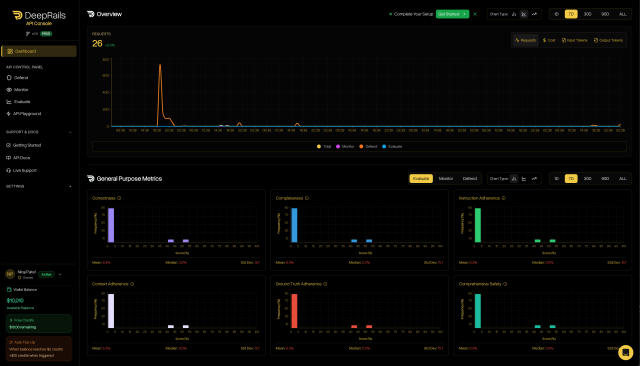
The API platform offers a significant financial moat and growth opportunity, driven by its remarkable profitability. DeepRails’ SaaS/API Platform enables organizations to safeguard LLM output. Depending on the model usage, the API profit margins range from 178% to 663%. Generally, the margins exceed 200%, which is astounding. These extremely high margins mean the company’s fully developed SaaS/API’s need minimal marginal cost to grow.
Read More: Understanding the “Completeness” & “Corrective” Metric in LLM Evaluation for Accuracy
Further upside from two joint venture contracts could generate $500k–$1.5M in revenue. Additionally, a 30% profit share is offered on new enterprise accounts. In turn, financial success relies on its evaluation logic and is supported by an estimated $3 million in research and development funding.
Specific Performance Metrics
DeepRails also provides a comprehensive set of Guardrail Metrics designed to measure key quality dimensions. For instance, the Completeness metric evaluates whether an AI response thoroughly and accurately addresses all aspects of a user’s query. It returns a continuous score from 0 to 1, ensuring the response has high coverage, detail, and depth.
It also guarantees relevance and logical coherence. This metric is 53% more accurate than leading alternatives. Other critical metrics include Correctness. It is 45% more accurate than competitors. Other metrics are Adherence metrics (Instruction, Context, Ground Truth), Comprehensive Safety, and Adversarial Robustness.
DeepRails Evaluation Engine
DeepRails utilizes its proprietary engine, Multimodal Partitioned Evaluation (MPE), for all evaluations across its Defend, Monitor, and Evaluate API’s. MPE overcomes the limitations of single-judge evaluators by implementing four critical pillars. First is the Partitioned Reasoning. These are large input/output pairs segmented into smaller, verifiable units tailored to specific guardrail metrics. The second is Dual-Model Consensus. Two distinct Large Language Models (LLMs), often from different providers, judge each unit independently.
The DeepRail model judges itself, which mitigates single-model bias. The third is Confidence Calibration, as LLM Judges self-report their confidence levels. MPE uses these levels for confidence-aware weighting when aggregating results, dampening spurious votes. The fourth is Reasoned Judging. It is carefully engineered prompts that encourage structured, chain-of-thought style reasoning. A reasoning that improves the fidelity of assessments on complex, multi-step tasks.
DeepRails Guardrail Metrics
The DeepRails platform tracks specific performance metrics and provides a comprehensive set of Guardrail Metrics to measure key quality dimensions. For instance, the Completeness metric evaluates whether an AI response thoroughly addresses all aspects of a user’s query. Additionally, it ensures that the reaction accurately encompasses all elements.
The metric returns a continuous score from 0 to 1. This scoring ensures the response has high coverage, detail, depth, relevance, and logical coherence. This metric is 53% more accurate than leading alternatives. Other important metrics include Completeness and Correctness, which are 45% more accurate than those of competitors. Additionally, DeepRails features several evaluation metrics, including Adherence metrics (Instruction, Context, Ground Truth), Comprehensive Safety, and Adversarial Robustness.
Conclusion
DeepRails is not merely a technology business. It is a profitable business with a validated service model. The company is a high-growth, bootstrapped AI SaaS and consulting business that maintains a 65% profit margin. This newly developed SaaS/API Platform opens a hyper-growth Annual Recurring Revenue (ARR) channel for a new owner or investor.
Sources
1. AI Consulting and SaaS Business Overview. (2025). Deeprails.com
2. Classified Asking Price History. (2025). Flippa.com
3. DeepRails. (2025). Completeness. DeepRails.com
4. DeepRails, Inc. (2025). DeepRails – Guardrails for LLM workflows. DeepRails.com
5. DeepRails. (2025). Multimodal Partitioned Evaluation. LLM Evaluations. DeepRails.com
Multimodal Partitioned Evaluation (MPE) is the engine that powers all DeepRails evaluations across Monitor and Defend.
Disclosure: This Page may contain affiliate links. We may receive compensation if you click on these links and make a purchase. However, this does not impact our content.


+ There are no comments
Add yours